

Community Health Worker (CHW) programs often grow faster than their training plans.
As programs expand, experienced CHWs are frequently promoted into supervisor roles. They know the community, understand the work and are trusted by their peers.
What they often do not receive is training for the supervisor role itself.
This is a common program-level gap, and one that can affect consistency, retention, and outcomes if left unaddressed.
This article looks at why CHW supervisors need different training and support than frontline CHWs, and what effective organizations do to set supervisors up for success.
Is your program ready to support its supervisors?
We work with organizations to build structured supervisor training that fits how your program actually operates.
Talk to us about supervisor training →Common Challenges CHW Supervisors Face
Many CHW supervisors step into their roles with little preparation beyond their CHW experience. As a result, they may struggle with challenges such as:
- Balancing peer relationships with supervisory responsibilities
- Providing feedback to former colleagues
- Translating program goals into day-to-day expectations
- Managing documentation, reporting, and compliance tasks
- Supporting CHWs emotionally while maintaining boundaries
- Navigating pressure from both leadership and frontline staff
These challenges are not a sign that supervisors are unqualified. They are a sign that the role itself requires new skills and support.
How the Supervisor Role Differs from Frontline CHW Work
Frontline CHW work focuses on direct service, relationship-building, and community engagement. Supervisory work shifts the focus.
National CHW guidance consistently distinguishes supervision from frontline CHW work, noting that supervisors are responsible for consistency, accountability, and support across teams.
CHW supervisors are responsible for:
- Supporting multiple CHWs, not just individual clients
- Ensuring consistency across staff and sites
- Reinforcing scope of practice and program standards
- Coaching, not just helping
- Managing performance while maintaining trust
This change can be difficult, especially for supervisors who were promoted because of their strength as CHWs. Skills that make someone an excellent CHW do not automatically translate into supervisory skills.
That is why supervisor training should not be treated as an extension of CHW Core Competencies training.
Why Supervisor Training Matters at the Program Level
Research on CHW supervision shows that supportive, well-structured supervision is strongly linked to CHW motivation, retention, and effectiveness—especially when organizations invest in clear roles and systems rather than relying on informal supervision.
When supervisors are expected to “figure it out,” programs often see predictable issues:
- Inconsistent guidance across teams
- Unclear expectations for CHWs
- Burnout among supervisors and staff
- Increased turnover
- Supervisors spending time putting out fires instead of building capacity
When supervisors are trained and supported, the opposite tends to happen.
Effective supervisor training helps programs:
- Create shared expectations and language
- Improve communication and feedback loops
- Support CHWs more consistently
- Reduce role confusion and stress
- Strengthen accountability without harming relationships
In short, training supervisors strengthens the system, not just the individual.
What Effective Supervisor Training and Support Looks Like
Ready to build this kind of support into your program?
We can help you think through what structured supervisor training looks like for your team and your goals.
Talk to us about supervisor training →Strong organizations take a program-level approach to supporting CHW supervisors.
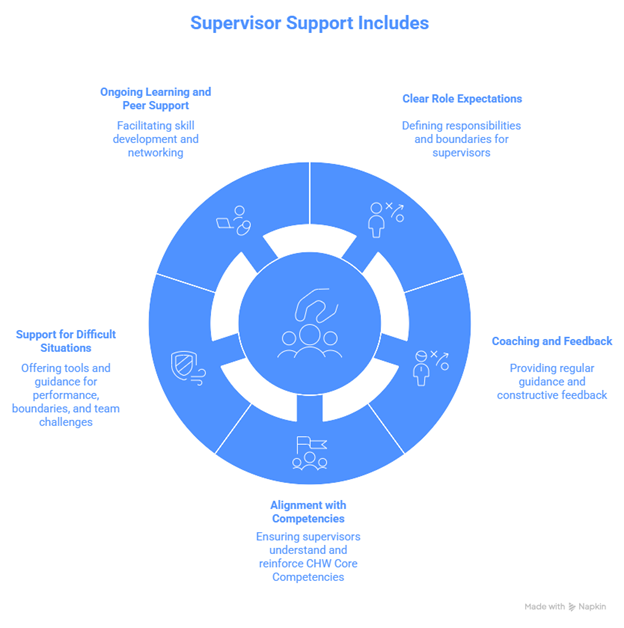
This often includes:
Clear Role Definition
Supervisors are trained on how their role differs from CHWs and where their responsibilities begin and end.
Leadership and Communication Skills
Supervisors learn how to:
- Give constructive feedback
- Coach rather than fix
- Support staff without taking on their work
- Navigate difficult conversations
Alignment With CHW Core Competencies
Supervisors understand the same Core Competencies CHWs are trained on, so expectations are consistent and reinforced.
Ongoing Support, Not One-Time Training
Supervisors have access to continued learning, peer support, and opportunities to reflect and build skills over time.
Organizational Backing
Leadership recognizes supervision as skilled work and provides time, structure, and support for it.
How Supporting Supervisors Improves Retention and Outcomes
CHWs are more likely to stay in their roles when they feel supported, understood, and guided—not just managed.
Well-supported supervisors help:
- Reduce burnout among CHWs
- Catch issues early before they escalate
- Maintain consistent practices across the program
- Build trust between staff and leadership
Over time, this leads to stronger teams and more stable programs.
Moving Forward
Promoting CHWs into supervisor roles is often the right decision. Supporting them after promotion is what makes the difference.
Programs that invest in supervisor training and support are better positioned to grow sustainably, support their staff, and achieve their goals.
Programs that invest in supervisor training are better positioned to grow sustainably, retain staff, and maintain consistency at scale. If you’re exploring how to strengthen supervision in your CHW program, we’re happy to help you think through what that could look like.
Strengthening supervision in your CHW program?
We work with organizations to build structured supervisor training that fits how your program actually operates.
Talk to us about supervisor training →