

January often brings a familiar question for Community Health Worker (CHW) programs:
Who should we train first: CHWs or supervisors?
Some organizations start with CHW Core Competencies. Others begin with supervisors. Some try to train everyone at once. And some delay supervisor training until problems show up.
There is no single right answer for every program. But there are clear patterns that can help you decide what makes sense for your team, timeline, and goals.
This article is meant to help program managers, coordinators, and leaders think through training sequence practically before the year fills up with deadlines.
Why Training Sequence Matters
CHWs and supervisors play different roles. Their training needs are not the same, and one should not be treated as an add-on to the other.
When training is sequenced well:
• CHWs know what is expected of them
• Supervisors know how to support, guide, and evaluate CHWs
• Programs reduce confusion, burnout, and rework later
When training is sequenced poorly:
• CHWs get mixed messages
• Supervisors rely on guesswork instead of shared standards
• Programs spend more time fixing issues than preventing them
When CHWs Should Be Trained First
In many programs, Core Competencies training for CHWs is the right place to start.
This is usually true when:
• You are onboarding new CHWs
• Your CHWs have varied backgrounds or experience levels
• Your program is standardizing roles, scope, or expectations
• Supervisors already have some experience managing CHWs
Core Competencies training helps CHWs build a shared foundation. It clarifies:
• The CHW role and scope of practice
• Core skills like communication, documentation, outreach, and navigation
• Professional boundaries and expectations
• How CHWs support individuals and communities within systems
Without this foundation, supervisors often end up explaining the role over and over, sometimes inconsistently.
Training CHWs first gives supervisors something solid to supervise against.
When Supervisors Should Be Trained First
In other cases, supervisor or leadership training should come first.
This is often the better choice when:
• Supervisors are new to managing CHWs
• Supervisors were promoted from CHW roles without formal leadership training
• The program is growing quickly
• You are seeing issues with communication, expectations, or performance support
Supervisors shape how training is applied day to day. If they are unclear on:
• The CHW role
• How to coach rather than fix
• How to support CHWs without overstepping
• How to balance reporting, outcomes, and trust
Then even strong CHW training can fall flat.
Training supervisors first helps ensure they are ready to reinforce what CHWs learn and support skill-building over time.
Just make sure you have supervisors. Research on CHW supervision shows that supportive, well-structured supervision plays a key role in CHW motivation, retention, and effectiveness, especially when supervision is aligned with organizational expectations rather than improvised.
When Training Can or Should Overlap
Some programs ask whether they should train supervisors and CHWs together.
This can work in limited, intentional ways, especially for smaller teams.
Overlap may make sense when:
• You are rolling out a new program or service model
• You want shared understanding of goals and values
• The content focuses on collaboration, communication, or systems context
However, overlap should not replace role-specific training.
A common approach is:
• Shared orientation or high-level context
• Separate, role-specific training paths
• Ongoing alignment through supervision and team practices
Common Mistakes in Training Sequence
Programs often run into trouble when they:
• Train supervisors on the fly
• Treat supervisor training as optional
• Train supervisors only after problems appear
• Assume one training fits all roles
• Rush training to meet a deadline
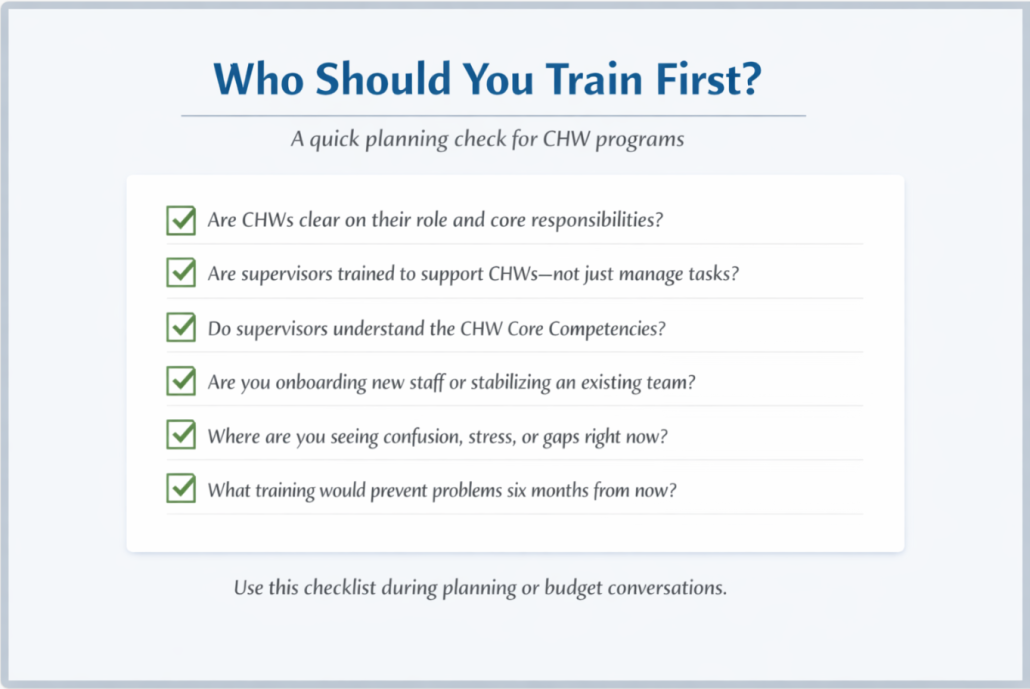
A Simple Decision Checklist
As you plan training for the year, ask:
• Are our CHWs clear on their role and core responsibilities?
• Are supervisors trained to support CHWs, not just manage tasks?
• Do supervisors understand the CHW Core Competencies?
• Are we onboarding new staff or stabilizing an existing team?
• Where are we seeing confusion, stress, or gaps right now?
• What training would prevent problems six months from now?
Moving Forward
Strong CHW programs invest in both CHWs and supervisors, intentionally and early.
If you are exploring how to structure organizational CHW Core Competencies training, it may help to learn more about options designed specifically for teams, not individual enrollment.
Taking time now to plan training sequence can save time, energy, and frustration later, and set your program up for a steadier year ahead.